
Honest marketing means making the truth easier to understand—not making a fiction easier to believe.
Imagine two plumbers on the same street.
One does excellent work. He arrives when he says he will. He explains the problem, charges what he quoted, and cleans up before leaving. His website says: “Plumbing services. Contact us.”
The other has a beautiful website. “The city’s most trusted plumbing experts.” Stock photographs of smiling technicians. A page full of promises. A countdown offering a discount that somehow expires again tomorrow.
You need a plumber. You have never met either man.
Which one looks more trustworthy?
That is the uncomfortable part of marketing. The business doing the best work does not automatically do the best job of explaining it.
But there is another uncomfortable part.
Once you discover how much presentation can influence trust, you can become more interested in looking trustworthy than in being worthy of it.
That is where storytelling becomes fiction.
Honest marketing does not mean being invisible
I work in marketing and software. I do not think the answer is to stop selling, delete your website, or wait quietly for people to discover your sincerity.
If your service solves a real problem, explaining that clearly is useful.
A customer should not need a detective to work out what you do, who you help, or why your approach matters. A photograph of your actual work, a clear explanation, and a customer’s genuine words can help someone make a better decision.
Honest marketing makes the truth easier to understand.
The problem starts when we use the same tools to make something untrue easier to believe.
There is a difference between explaining your strengths and inventing a reputation. Between choosing a useful example and presenting an exceptional result as the normal outcome. Between making a page attractive and using its appearance to imply a scale you do not have.
You can be small and professional.
You can be new and capable.
You do not need to pretend to be established to deserve a chance.
The gap Allah asks us to confront
Allah asks:
“O you who have believed, why do you say what you do not do?”
[Surah As-Saff 61:2, translation: Saheeh International].[1]
The next verse makes the seriousness unmistakable:
“Great is hatred in the sight of Allah that you say what you do not do.”
[Surah As-Saff 61:3, translation: Saheeh International].[2]
These verses are not a copywriting manual. Their demand reaches much further than business. But a Muslim business owner cannot leave his marketing outside the examination of his words and deeds.
“Customer first.”
“Always available.”
“We treat your business like our own.”
These are not just nice arrangements of words. They create expectations about how you will behave when someone pays you.
What happens when the customer needs a refund? When the job becomes inconvenient? When delivering what you promised costs more than you expected?
That is where your brand meets your character.
I think we sometimes spend too much time choosing the words we want associated with our business and too little time asking whether our ordinary behaviour supports them.
If you say your business is built on amanah, the test is not whether amanah appears on your About page.
The test is what happens when keeping the trust becomes expensive.
The wet grain beneath the surface
There is a narration that makes this very concrete.
The Prophet ﷺ passed a heap of food, put his hand into it, and found moisture beneath the surface. The seller explained that rain had reached it.
The Prophet ﷺ asked why the wet part had not been placed on top so people could see it, then warned against deception. [Sahih Muslim 102].[4]
Notice what matters here.
The buyer could see the surface. The problem was what that surface concealed.
That should make us think carefully about the way we present our businesses.
A product page can show the attractive part while hiding an important limitation. A proposal can emphasise the monthly price while making the commitment period difficult to find. A software demonstration can look seamless while leaving out the manual work required to make it function.
The application is mine; the principle comes from the narration: relevant truth should not be arranged so that the customer is unlikely to notice it.
That does not mean putting every minor imperfection in your headline. It means not burying something that would reasonably change the decision.
If something important is wet, do not build the sale around the dry surface.
Proof Before Polish: 4 Steps for Honest Marketing
Here is the honest marketing rule I would put above every brief:
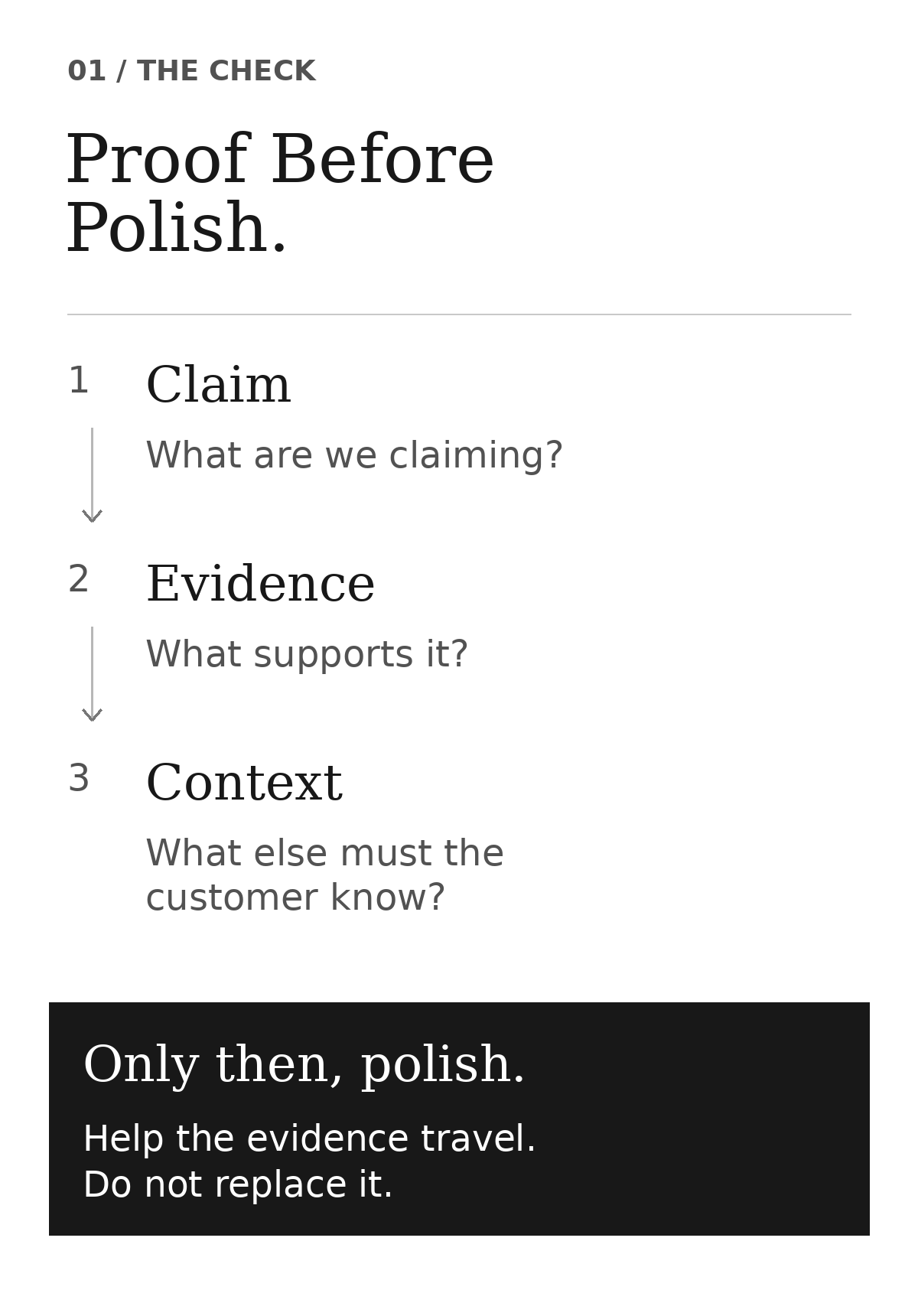
Proof Before Polish.
Before asking, “How do we make this sound impressive?”, ask three simpler questions.
What are we claiming?
Not just the literal sentence. What will a reasonable person understand from the whole presentation?
What supports it?
An actual result? A service process we consistently follow? A current qualification? A customer’s real experience?
What does the customer need to know alongside it?
A limitation, a condition, a timeframe, or the fact that the result is not typical?
Only then should we work on the headline, design, photographs, and story.
Polish has a job. It should help the evidence travel.
It should not stand in for evidence that does not exist.
If a claim collapses when someone asks, “Can you show me?”, the answer is not a stronger adjective.
It is a smaller claim or better work.
What this looks like on a real website
Start with testimonials.
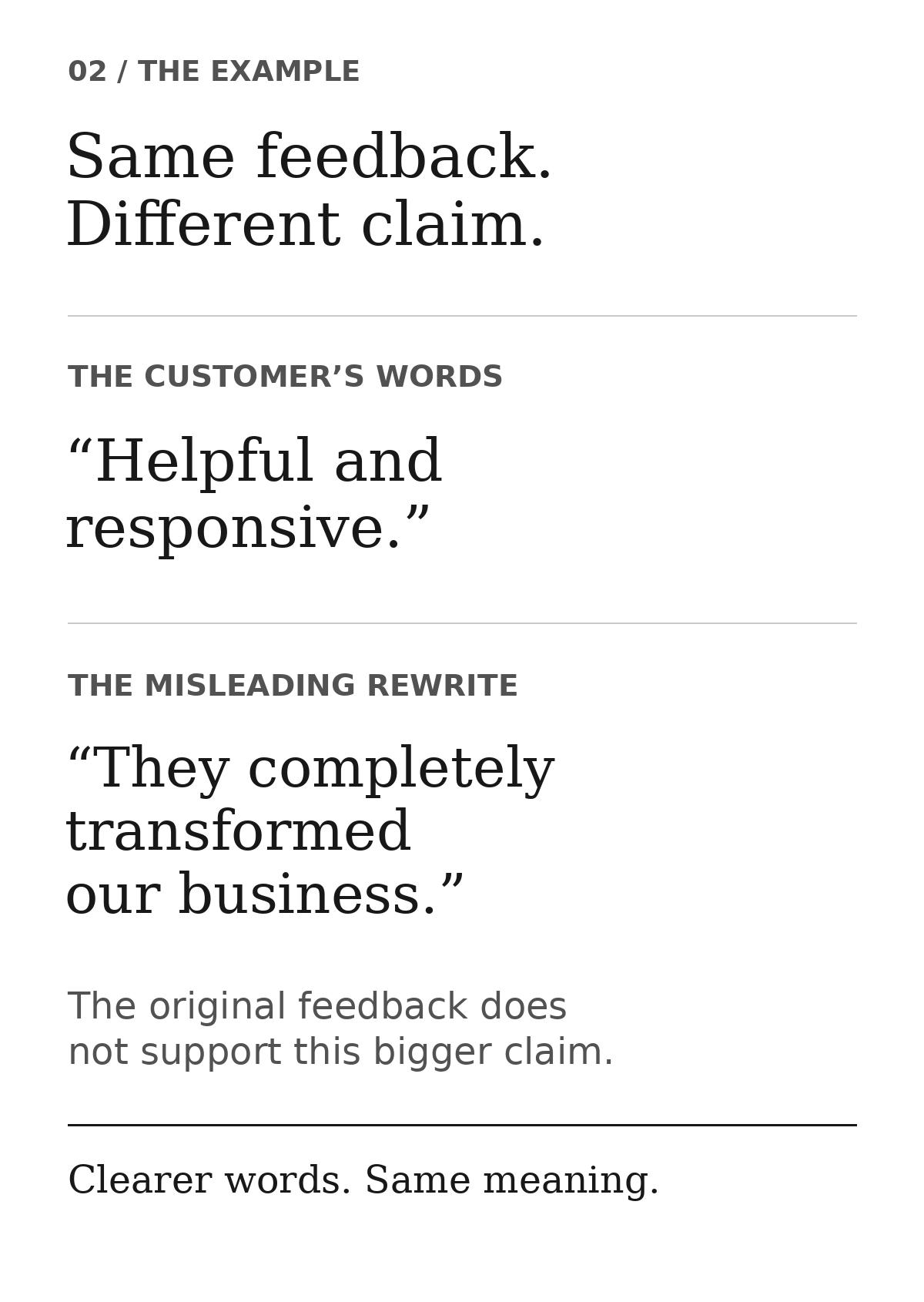
Use what the customer actually said. Get permission. You can tidy an agreed quotation for readability without changing its meaning, but do not manufacture enthusiasm or turn modest praise into a dramatic transformation.
“Helpful and responsive” does not become “They completely transformed our business” because the second version fits your landing page better.
If you cannot yet show customer feedback, explain your process. Show your work. Do not invent a customer to fill a design block.
Then look at the logos.
“Trusted by” can mean different things. Did the company buy your product? Did one employee attend a free session? Did you work there years ago? Did you do the work through another agency?
Describe the actual relationship, obtain the necessary permission, and do not imply an endorsement you were never given.
The logo may be genuine. The impression can still be false.
Then the scarcity claims.
A real deadline can help someone decide. A genuine capacity limit is useful information. If you can onboard only two clients this month, say that.
But do not show “two spaces left” if your answer would be yes to the next twenty enquiries.
Do not restart a timer for every visitor while pretending everyone is facing the same final deadline.
You have not discovered a clever growth tactic. You have created a reason for someone to believe something untrue.
Finally, look at your promises about results.
There is a difference between “We build and manage your campaigns” and “We will double your revenue.” The first describes work you can commit to. The second depends on much more than your effort.
If you show a successful result, explain enough context for it to be meaningful. What changed? Over what period? What else contributed? Is this a single example or a pattern you can demonstrate?
You can be confident without pretending uncertainty has disappeared.
Your origin story does not need a costume
The same principle applies to the founder story.
You do not need to turn every early difficulty into an epic struggle. You do not need to erase help, make every decision look deliberate, or speak as though success was inevitable.
Perhaps your business began because you needed an income. Perhaps you noticed a problem while working somewhere else. Perhaps you tried several things, most did not work, and one slowly became useful.
That is a story.
You can shape it without falsifying it. Choose the details that explain what you learned and why your business exists. Leave out private information. Keep it readable.
But do not borrow a more impressive life because you think yours will not convert.
And do not put invented experiences into an AI tool and ask it to make them sound like your memories.
AI can help you find words for something that happened.
It cannot make something happen retroactively.
A successful sale can still be a bad transaction
The Prophet ﷺ taught that when buyer and seller speak truthfully and explain the goods, their transaction is blessed; when they lie or conceal, its blessing is lost. [Sahih al-Bukhari 2079].[3]
That changes the scoreboard.
A conversion is not, by itself, proof of honest marketing.
Someone may have bought because they understood the offer. Or because they misunderstood something you were happy not to correct.
The payment notification looks the same.
The transaction is not the same.
Allah also prohibits consuming one another’s wealth unjustly and permits lawful trade by mutual consent. [Surah An-Nisa 4:29].[5]
A checkout click should not become our excuse for being careless about what we led someone to believe. We should want the customer to choose the offer we are actually making, not a more attractive version that exists only in their head.
For me, that is the difference between persuasion and manipulation.
Persuasion helps you understand why something may be right for you.
Manipulation needs you not to notice why it may not be.
Honest marketing is not a trick for getting richer
There is a tempting way to package all this advice: be honest because honesty always wins more customers.
I do not think we should make that promise.
Sometimes disclosing a limitation will lose the sale. Sometimes a competitor’s exaggerated pitch will look more exciting. Sometimes the customer wants a guarantee you cannot truthfully give.
Being honest does not mean those moments stop hurting.
It means we do not make obedience conditional on getting the outcome we wanted.
If our commitment is, “I will tell the truth as long as it converts better,” then conversion is still in charge.
This does not mean accepting poor communication, avoiding profit, or refusing to improve your offer. Charge properly. Explain your value. Learn to sell well.
Just do not ask your principles to wait outside while you close the deal.
Start with the promise you cannot comfortably defend
You do not need a complete rebrand to apply this.
Open your homepage, latest proposal, or most successful advertisement.
Find the strongest promise.
Not the easiest typo to fix. The sentence you would feel uncomfortable explaining if a careful customer asked exactly what it meant.
Run it through Proof Before Polish.
What are we claiming? What supports it? What needs to sit alongside it?
If the promise is true, make the evidence clearer. If it is too broad, narrow it. If it describes the business you hope to become, do not present it as the business you already are.
Then look beyond the page.
If you promise fast replies, decide who replies. If you promise a smooth handover, make sure someone owns it. If you promise straightforward cancellation, try cancelling your own service.
The copy can reveal an operational problem. Fixing only the copy may not be enough.
Build a business your story can keep up with
I want businesses doing good work to tell better stories.
I want the quiet, capable person to explain his value without feeling that selling is somehow beneath him. I want small teams to look professional without pretending to be large. I want customers to see the useful difference between one offer and another.
But the story should lead people towards what is there.
Not away from what is missing.
Your website is not the business. Your founder story is not your character. Your values page is not proof that you live those values.
The work is the work.
Let honest marketing make it visible.
For a related look at excellence, trust and business ambition, read Competition Is for Losers. So Is Monopoly.
Build something worth talking about. Then tell the truth about it well.
O Allah, grant us lawful provision, truthful speech, and the courage to honour our promises when doing so is difficult. Put barakah in our dealings, and protect us from gaining a sale at the expense of a trust. Ameen.