The uncomfortable possibility behind the “Cognitive Commons”, and why the biggest danger of AI may not be unemployment at all.
There is a strange contrast to life in Gordon’s Bay. One moment I’m thinking about physical things. The farm. Feed. Equipment. Something that has to be repaired with your hands because no amount of prompting is going to tighten the bolt for you.
Then I open my laptop. Software. Automation. AI. Code. Marketing. Systems. And increasingly, I can ask a machine to do something that would once have taken me hours. Write the code. Analyse the problem. Draft the strategy. Research the subject. Explain the error. Rewrite the proposal. Summarise the document. Generate the ideas.
Sometimes it still amazes me. I have spent years in technology, and I genuinely believe AI is one of the most powerful tools we have ever created. But lately I have been thinking about a more uncomfortable question:
What happens when the tool becomes so good that we stop developing the abilities the tool is supposed to assist?
Not when AI takes our jobs. When AI takes our struggle. Because those are two very different problems.
A fascinating research paper published in 2026 gave me a name for something I have been thinking about for a long time:
The Cognitive Commons.
A central reservoir labelled professional expertise is surrounded by six professions: medicine, software, engineering, law, accounting and education. In each, experienced people pass knowledge to the next generation, younger people grow more capable and take their place, and the shared reservoir stays healthy because every generation rebuilds it.
The idea is unsettling. Perhaps the greatest threat from artificial intelligence is not that machines become intelligent. Perhaps it is that humans slowly stop becoming competent.
Contents (tap to open)
- First, Something Important About the Research
- What Exactly Is the Cognitive Commons?
- Expertise Has Always Been Regenerated Through People
- Imagine What Happens Inside a Software Company
- The Validation Tether
- We Are Already Seeing Warning Signs
- The Friction We Hate May Have Been Teaching Us
- I See This Differently Because I Am Also Raising Children
- Islam Never Treated Knowledge as Mere Information
- The Apprentice Matters More Than We Realise
- We Could Create Extremely Capable Incompetents
- I Am Not Arguing That We Should Stop Using AI
- Maybe the Goal Should Be AI-Assisted Struggle
- My Rule: Don’t Outsource What You Still Need to Learn
- Businesses Have a Bigger Responsibility Here
- Productivity Is Not the Highest Measure of a Human Being
- What I Want My Children to Understand About AI
- Five Rules for Using AI Without Surrendering Your Mind
- The Real AI Divide May Not Be Rich Versus Poor
- The Biggest AI Question Is Not “What Can I Automate?”
- We Don’t Want to Become Passengers in a Civilisation We Built
First, Something Important About the Research
There are posts circulating online claiming researchers have “mathematically proved” that AI will cause something worse than mass unemployment. That is not quite what happened. The paper I am discussing is Nolan Lovett’s:
It was published in Human Resource Development Review in 2026. The paper does not mathematically prove that humanity will lose its expertise. Instead, Lovett develops a conceptual framework describing how widespread AI adoption could interfere with the way professional expertise is passed from one generation to another.
That distinction matters. We don’t need to exaggerate good research to make the argument interesting. The actual idea is powerful enough.
What Exactly Is the Cognitive Commons?
Think about any mature profession. Software engineering. Medicine. Law. Accounting. Architecture. Engineering. Carpentry. Journalism. Marketing.
There are experienced people inside those professions who seem to simply know things. A senior developer looks at a piece of code and senses something is wrong. An experienced doctor notices that one symptom doesn’t fit the apparent diagnosis. A seasoned attorney sees a clause in a contract and immediately recognises a potential problem. A mechanic hears an engine and knows something isn’t right before connecting diagnostic equipment.
Where did that knowledge come from? Not from reading one book. Not from completing a course. And certainly not from asking ChatGPT.
It accumulated through thousands of encounters with reality. Mistakes. Corrections. Repetition. Failures. Feedback. Awkward conversations. Bad assumptions. Unexpected outcomes. Long nights. Boring junior work. And slowly, something changed inside that person.
Knowledge became judgement.
Lovett describes this as Internalized Mastery, deep expertise built through sustained practice and experience. He contrasts this with Distributed Mastery, where someone becomes highly skilled at coordinating people, technology and AI systems without necessarily possessing every underlying skill themselves.
Both are useful. The danger begins when Distributed Mastery replaces Internalized Mastery entirely.
Expertise Has Always Been Regenerated Through People
A profession is bigger than the people currently working inside it. Senior engineers retire. Doctors retire. Accountants retire. Teachers retire.
New people enter the profession. Those juniors struggle. They learn. They make mistakes. They become competent. Eventually they become experts. Then they train the generation behind them.
The cycle looks something like this:
Junior → Intermediate → Senior → Mentor → Next Generation
That process quietly regenerates society’s professional knowledge.
Five stages of a career, junior, intermediate, senior, mentor and next generation, form a pipeline that knowledge flows through. AI takes over junior work and the junior stage narrows sharply in 2026. For years the senior and mentor stages still look full. Then, around 2034, seniors retire and there is almost no one to replace them: the shortage arrives about eight years after the optimisation.
Lovett argues that this shared reservoir of capability resembles a commons. Hence the term:
The Cognitive Commons
And commons have a famous problem. Individual actors can make perfectly rational decisions that collectively damage the resource everybody depends on.
Imagine What Happens Inside a Software Company
This example is close to home for me. Imagine I have ten developers. Three senior developers and seven juniors.
Then AI coding systems become extraordinarily capable. Suddenly one experienced developer using AI can produce what previously required several junior developers. From a business perspective, the calculation looks obvious.
Why employ seven juniors? Keep the seniors. Give them AI. Increase margins. Finish projects faster. Reduce payroll. The productivity numbers look brilliant.
But something else has happened. We have removed seven people from the apprenticeship pipeline. Fast-forward ten years. The seniors are leaving.
Where are their replacements?
We removed them. That is the problem. And it is not limited to software.
Consider Law
Junior lawyers historically spend enormous amounts of time reviewing documents. Boring? Absolutely. Efficient? Probably not.
But while reviewing those documents, something else is happening. They are seeing contracts. Patterns. Arguments. Mistakes. Language. Case histories. Human behaviour. They are slowly developing legal instinct.
Then AI arrives and reviews ten thousand documents before lunch. That sounds fantastic. Except now the associate isn’t reviewing those ten thousand documents. So where does that associate obtain ten thousand documents worth of experience? That is the question.
Or Medicine
AI-assisted diagnostic systems may become incredibly good at recognising diseases. We should use them.
But a doctor who learned medicine by examining thousands of patients possesses something very different from a doctor who learned mainly to approve AI-generated diagnoses. One has developed pattern recognition internally. The other may have developed expertise in operating the system.
Both abilities matter. But they are not interchangeable. And that brings us to what I think is one of the most important concepts in the entire paper.
The Validation Tether
AI enthusiasts frequently say: “Don’t worry. A human will always verify the AI.” Fine.
Which human?
And more importantly:
How did that human become qualified to verify it?
This is the paradox Lovett calls the Validation Tether. Effective human oversight of AI depends upon exactly the type of deep expertise that excessive AI dependence could weaken. Think about that carefully.
AI makes mistakes. So we need experts capable of identifying those mistakes. But if future professionals develop by relying heavily on AI rather than building the underlying expertise themselves, their ability to recognise those mistakes may gradually decline. Eventually we could have humans “checking” machines without possessing enough independent competence to know whether the machine is correct.
That is not meaningful oversight. That is ceremony. Someone still clicks Approve. But nobody truly knows.
An AI system sends a stream of professional decisions, such as a diagnosis, code and legal advice, through a human review checkpoint. An experienced reviewer spots a subtle mistake and rejects it. Over time the reviewer is replaced by generations who learned mostly through AI, and their knowledge networks weaken. Eventually a flawed output arrives, the reviewer hesitates, and approves it. The scene then reveals a loop: AI requires human expertise for validation, AI reduces opportunities to build that expertise, and human validation becomes weaker.
We Are Already Seeing Warning Signs
This does not prove some inevitable intellectual collapse. But there are enough warning lights flashing that I think we should pay attention.
Research involving Microsoft and Carnegie Mellon examined hundreds of real-world examples of knowledge workers using generative AI. One particularly interesting finding was that people who had greater confidence in AI tended to report using less critical-thinking effort themselves.
The reverse was also interesting. People who had greater confidence in their own abilities tended to engage in more critical thinking while using AI.
That relationship should make every company rushing into AI stop and think. Because AI dependence could potentially become self-reinforcing.
You trust the machine. So you think less. Because you think less, your own capability develops more slowly. As your confidence falls, your dependence on the machine increases. And around we go.
This does not mean:
AI makes everyone stupid.
That would be lazy thinking about research examining lazy thinking. The conclusion is far more subtle.
How we use AI matters enormously.
The Friction We Hate May Have Been Teaching Us
We have become obsessed with removing friction. Every technology pitch promises it.
Faster. Easier. Instant. One click. Zero effort.
Usually, I love that stuff. I build systems partly because inefficient processes drive me mad. If software can turn a three-hour administrative process into fifteen seconds, wonderful. Automate it.
But we need to distinguish between two completely different kinds of friction.
Split screen. On the left, friction that wastes ability: repetitive tasks such as copying data and re-entering information pile up, then AI removes them, the person's mental load drops and capacity is freed. On the right, friction that creates ability: solving, writing and debugging strengthen the person's knowledge network. When AI removes these tasks too, the workload drops but the network stops developing.
Friction That Wastes Human Ability
Copying information between spreadsheets. Renaming files. Repeated data entry. Scheduling appointments manually. Formatting the same report every Friday. Automate that mercilessly. Then there is another kind.
Friction That Creates Human Ability
Solving the problem. Remembering the information. Writing the first draft. Debugging the failure. Working through the calculation. Trying the argument. Getting it wrong. Receiving criticism. Trying again.
That friction looks inefficient when measured purely through immediate output. But learning often is inefficient.
A child struggling to solve a maths problem manually is slower than a calculator. That does not mean the calculator should do the learning.
I See This Differently Because I Am Also Raising Children
This is where the subject becomes much more personal for me. When you are teaching children, the productivity mindset suddenly looks ridiculous.
Imagine your child is working through something difficult. You could solve it for them in thirty seconds. They might take thirty minutes. From a productivity perspective, allowing them to struggle makes absolutely no sense.
But you are not optimising output. You are developing a human being.
The thirty minutes is the product.
The frustration. The concentration. The mistakes. The moment when the answer finally clicks. That is what is changing the brain.
A child works on a maths problem, 3x plus 7 equals 25. They try, get it wrong, erase it, think and try again while a timer runs to 30 minutes, and a network of connections grows above them until they solve it. In a second scenario AI gives the correct answer at 3 seconds and almost no connections form. The comparison: fastest answer, 3 seconds; most learning, 30 minutes.
Adults somehow forget this about ourselves. We begin treating our own struggle as wasted time.
AI appears and says: “I can do that for you.” And we immediately answer: “Alhamdulillah. Please do.”
Sometimes that is exactly the right answer. Sometimes it isn’t.
Islam Never Treated Knowledge as Mere Information
This is where I think our Islamic understanding of knowledge becomes incredibly relevant. Allah says:
“Are those who know equal to those who do not know?”
Qur’an 39:9
Knowledge in Islam is not merely the possession of information. It carries responsibility. Understanding. Humility. Action. Allah also says:
“And do not pursue that of which you have no knowledge.”
Qur’an 17:36
That verse feels remarkably relevant in an age where anyone can generate a confident 2,000-word explanation about something they barely understand. Including me. Including you. Including the AI.
Information has become cheap. Confidence has become cheap.
Beautifully formatted ignorance has become almost free.
What remains expensive is understanding. Real understanding still costs time. Allah also tells us:
“Ask the people of knowledge if you do not know.”
Qur’an 16:43
There is something important in that principle. Teacher to student. Scholar to student. Craftsman to apprentice. Parent to child. Senior to junior. Generation to generation.
Knowledge has historically travelled through human beings. Destroy those chains and something far more valuable than productivity could disappear.
Knowledge Is an Amanah
I also think expertise can be understood as a form of amanah, a trust. A surgeon’s competence is a trust. A structural engineer’s competence is a trust. The person configuring cybersecurity for a hospital carries a trust. The accountant signing financial statements carries a trust. The developer building systems handling people’s personal information carries a trust. Allah says:
“Indeed, Allah commands you to render trusts to whom they are due…”
Qur’an 4:58
We normally think about trusts in terms of money, property and responsibility. But competence matters too. If society increasingly puts critical systems into the hands of people who know how to operate AI but do not understand the underlying domain, we create something incredibly fragile.
It may look advanced. It may look efficient. It may work beautifully. Until something unusual happens. And unusual situations are precisely where expertise becomes valuable.
The Apprentice Matters More Than We Realise
Every experienced professional was once annoying. Nobody remembers that part.
The senior engineer who solves problems in minutes once asked stupid questions. The confident surgeon once had shaking hands. The brilliant accountant once misunderstood something basic. The entrepreneur giving advice today once made embarrassingly obvious mistakes.
Expertise requires being bad before becoming good. AI introduces a fascinating possibility:
What if we could skip being bad?
I’m not sure we can. We may be able to skip producing bad work because AI can cover our weaknesses. But covering weakness and removing weakness are not the same thing.
A junior developer using AI might produce code that looks like senior-level work. But does he possess senior-level understanding? A new marketer might produce sophisticated copy. But does she understand psychology, positioning, persuasion and why those words work? A student might submit an immaculate essay. But did his mind wrestle with the argument?
The output can improve while the operator improves very little.
That is something we have never experienced at this scale before.
Two meters: quality of output and human understanding. While someone learns by doing, both rise together. When generative AI arrives, output quality jumps to near the top while understanding barely moves, and the gap between them is labelled the competence illusion. In a second scenario the person studies, practises and uses AI to check their work, and both meters end up high.
We Could Create Extremely Capable Incompetents
It sounds contradictory. It isn’t. Imagine someone who can:
- Build applications
- Analyse financial statements
- Draft contracts
- Create advertising campaigns
- Write articles
- Generate business strategy
- Translate languages
- Produce technical documentation
But only as long as their AI systems are available. Take those systems away and very little remains.
That person is extraordinarily productive. But are they actually capable? Perhaps we need to distinguish between:
Capability With Infrastructure and Capability Inside the Human Being
We need both. The mistake would be believing the first makes the second obsolete.
I Am Not Arguing That We Should Stop Using AI
This is where conversations about AI usually become silly. One side says: “AI will solve everything.” The other says: “AI is destroying humanity.” I don’t find either position useful.
I build with AI. I use AI constantly. I encourage businesses to understand AI. I believe companies that completely ignore it are going to face serious problems. There are many tasks humans genuinely should not be wasting their lives doing anymore.
AI can also be an extraordinary teacher. It can challenge assumptions. Explain difficult concepts. Give feedback. Generate alternative perspectives. Simulate arguments. Expose weaknesses. That is the AI I want.
Not: Think instead of me.
But: Help me think better.
There is a massive difference.
Maybe the Goal Should Be AI-Assisted Struggle
That sounds contradictory too. But consider the difference.
Instead of asking: “Write this strategy for me.” Try: “Here is my strategy. Attack it.”
Instead of: “Solve this problem.” Try: “Don’t give me the answer yet. Ask me questions that help me solve it.”
Instead of: “Write this code.” Try: “Explain why my approach is failing.”
Instead of: “Summarise this book so I don’t have to read it.” Try: “After I read this chapter, test whether I actually understood it.”
That creates a completely different relationship with technology. One replaces cognition. The other strengthens it.
Two scenarios with the same AI. In scenario A the person asks: solve this for me. The AI returns a finished answer, the task is solved, and the person's knowledge network barely changes: cognitive substitution. In scenario B the person asks: help me think through this. The AI asks questions and challenges each answer, the person revises their thinking, the task is solved, and their knowledge network grows much stronger: cognitive augmentation.
My Rule: Don’t Outsource What You Still Need to Learn
This is becoming one of the clearest principles I have for using AI:
Automate what you understand. Be careful automating what you still need to understand.
If you are a senior developer and AI generates boilerplate you have written five hundred times, wonderful. If you are a junior developer and have never understood what the generated code is doing, blindly producing it may be robbing you of something.
If you are an experienced copywriter using AI to create ten variations, great. If you have never learned persuasion and are outsourcing the entire process, you are building dependence before competence.
If you are an accountant who can independently verify the calculations, AI is leverage. If you cannot recognise a nonsensical result, AI becomes a liability disguised as leverage.
The same tool can strengthen one person and weaken another. Context matters.
Businesses Have a Bigger Responsibility Here
The Cognitive Commons idea becomes especially important when we move beyond individuals and start looking at organisations. Companies naturally optimise for themselves. I understand why.
If I can complete a project with three people instead of ten, commercially I have to consider it. My competitors will. Clients will expect faster delivery. Margins matter. Survival matters.
But companies also train the next generation of professionals. Whether we like it or not. A junior employee is not simply producing labour.
They are absorbing capability.
An organisation adopts AI automation. Its account labelled today fills with gains: cost down, speed up, output up. At the same time a quieter account, expertise debt, grows each time junior hiring, apprenticeships, practice or mentoring are cut. From 2026 to 2031 nothing seems wrong because experienced staff are still there. By 2036 they have left, and the debt becomes payable: senior talent shortage, weak AI oversight, loss of institutional knowledge and dependence on systems.
Perhaps businesses therefore need to preserve certain types of developmental work even when AI could perform them faster. Not pointless busywork. Not exploitation disguised as “experience”. Real apprenticeship.
Let the junior developer troubleshoot before showing them the AI diagnosis. Let the marketer develop a concept before asking AI for alternatives. Make employees explain why an AI-generated output is correct before approving it. Rotate people through genuine problems. Require independent reasoning. Pair juniors with seniors. Reward understanding, not merely output.
Perhaps we need to intentionally design learning friction back into AI-enabled organisations. That sounds inefficient. It probably is. So is training.
Productivity Is Not the Highest Measure of a Human Being
I keep coming back to this. Technology increasingly teaches us to measure human activity through output. Faster is better. More is better. Cheaper is better.
But a human being is not an API endpoint. Our purpose is not maximum tokens per second. There are processes whose value lies partly in what they turn us into.
Reading. Memorising Qur’an. Learning a craft. Raising children. Building a business. Studying. Writing. Teaching. Working through failure.
There are no shortcuts through some of these things because the transformation happens during the journey. The Prophet ﷺ said:
“Whoever follows a path in pursuit of knowledge, Allah will make easy for him a path to Paradise.”
Sahih Muslim 2699
I love the wording. A path. Knowledge has a path. You walk it. And walking changes you.
What I Want My Children to Understand About AI
I don’t want my children growing up afraid of artificial intelligence. They should understand it better than my generation does. They will live in a world where intelligent machines are everywhere.
But I also don’t want them thinking: Why learn something the machine already knows? Because that question misunderstands education.
You don’t learn mathematics because society lacks calculators. You learn mathematics because mathematics changes your ability to reason. You don’t write because society lacks text generators. You write because writing forces you to organise thought.
You don’t memorise because Google might disappear tomorrow. Memory gives your mind material to think with. You don’t learn history merely to recite dates. You learn it so that you can recognise patterns in human beings, power and civilisation.
Education is not merely about obtaining answers. It is partly about constructing the person capable of understanding those answers.
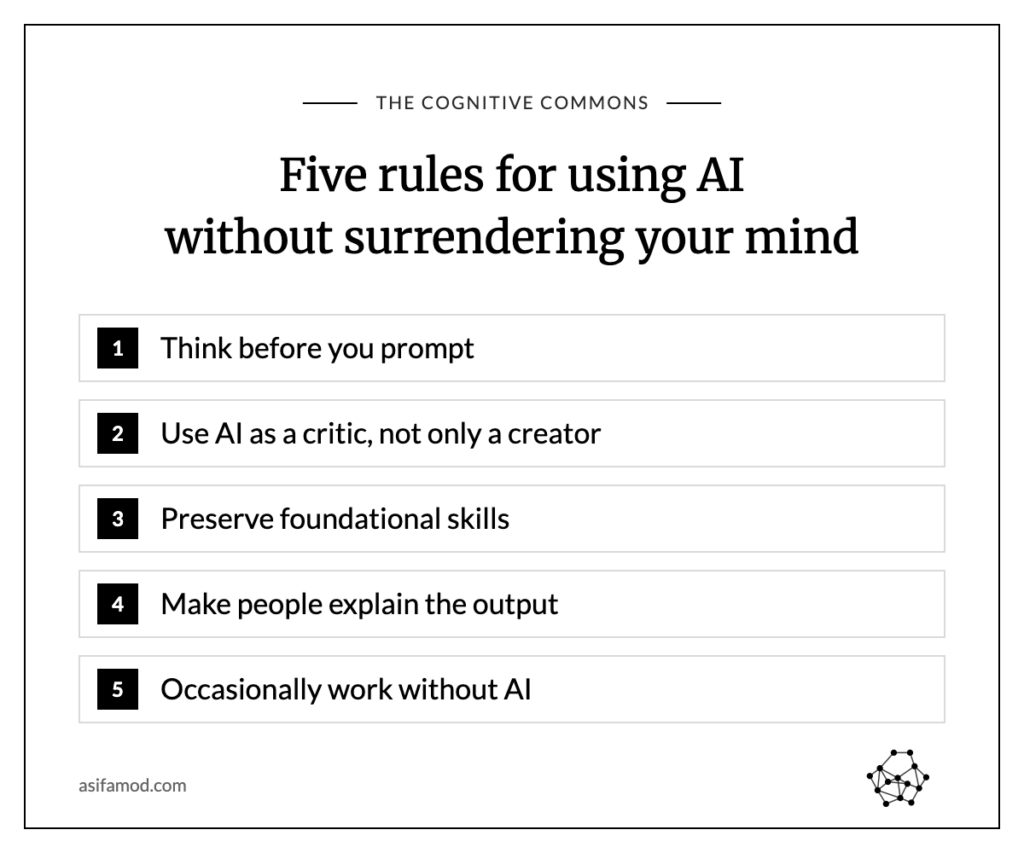
Five Rules for Using AI Without Surrendering Your Mind
I am still developing my thinking around this, but these principles increasingly make sense to me.
1. Think Before You Prompt
Give yourself a few minutes first. What do you think? Write it down. Then consult AI. Otherwise, the machine’s first answer can become the anchor around which your own thoughts form.
2. Use AI as a Critic, Not Only a Creator
Ask it to attack your reasoning. Find weaknesses. Present opposing arguments. Ask what you overlooked. AI becomes far more useful when it stops being a vending machine for finished answers.
3. Preserve Foundational Skills
There should still be things you can do without assistance. Write. Calculate. Reason. Research. Explain. Troubleshoot. Communicate.
Not because machines cannot help. Because humans still need an intellectual foundation from which to evaluate the machines.
4. Make People Explain the Output
If someone uses AI to produce code, strategy, analysis or research, ask:
Why is this correct?
If they cannot explain it, the task isn’t finished.
5. Occasionally Work Without AI
Not because AI is evil. For the same reason athletes sometimes train under resistance. You need to discover what remains inside you when the assistance disappears.
The Real AI Divide May Not Be Rich Versus Poor
People frequently talk about an AI divide. Those with access versus those without access. That certainly matters. But perhaps another divide is emerging.
People who use AI after developing competence.
And:
People who use AI instead of developing competence.
The first group could become astonishingly capable. A skilled engineer with AI. A knowledgeable doctor with AI. A brilliant teacher with AI. A thoughtful entrepreneur with AI. Their expertise becomes amplified.
The second group may appear equally capable for a while. Their outputs may look almost identical. And that is precisely what makes this dangerous.
You will not necessarily notice the difference on an ordinary Tuesday. You notice it when the system fails. When the data is wrong. When the model hallucinates. When the situation is genuinely novel. When two pieces of evidence contradict each other. When the obvious answer is wrong.
Then suddenly the difference between borrowed intelligence and internalised understanding becomes incredibly important.
Person A and Person B use the same AI. A thinks first, checks the AI and practises; B asks, copies and ships. On routine tasks their outputs look identical. Then a novel situation arrives and the AI gives a plausible but wrong answer. Person B approves it. Person A notices the inconsistency, investigates and rejects it.
The Biggest AI Question Is Not “What Can I Automate?”
It is:
What should I refuse to stop learning?
That question should be asked inside companies. Inside schools. Inside universities. Inside families. Inside professions. And inside our own homes.
What knowledge is important enough that humans must continue possessing it internally? Which skills require apprenticeship? Where is AI enhancing mastery? Where is it bypassing mastery? Who will train tomorrow’s experts?
And perhaps most importantly:
Who will still be able to tell when the machine is wrong?
Because there is something almost absurd about the future we could accidentally build. Machines producing extraordinary volumes of expert-looking work. Humans approving it. Nobody truly understanding it.
We Don’t Want to Become Passengers in a Civilisation We Built
That is the thought that stays with me. AI should extend human capability. Not hollow it out.
It should give the knowledgeable person greater reach. Give the creative person more tools. Give the teacher more ways to teach. Give the entrepreneur more leverage. Give the doctor more information. Give the engineer greater precision. Give the student better feedback.
But underneath all that technology there still needs to be a human being who understands something. Someone capable of saying:
“No.” “That doesn’t make sense.” “Something is wrong here.” “Show me the evidence.”
And perhaps most importantly:
“I don’t know.”
Those may become some of the most valuable sentences of the AI age. Because perhaps the real danger isn’t artificial intelligence becoming too confident. It is humans becoming confident without knowledge because the machine beside us always has an answer. Allah teaches us to say:
“My Lord, increase me in knowledge.”
Qur’an 20:114
Not: My Lord, increase my access to answers.
Knowledge. Understanding. Wisdom. Those still require something from us.
And perhaps that effort is not an inconvenience technology needs to eliminate. Perhaps it is part of the gift.
So yes, I will continue using AI. I will build with it. Teach my children about it. Automate with it. Push it. Experiment with it.
But increasingly, I want to ask myself one question before handing something over:
Am I using this machine to extend my mind, or am I slowly teaching my mind that it is no longer needed?
Because every shortcut has a destination. And we should probably make sure we still want to go there.
A person with a modest network of glowing connections sits beside an AI system. The scene splits into two futures. In replacement, AI takes over more and more thinking, grows larger and brighter, and the person's network fades. In augmentation, AI sends ideas and challenges to the person, who processes them, and their network becomes richer while the AI stays powerful beside them. The futures merge back to the centre and the screen goes dark with a question: is AI extending your mind, or teaching it that it is no longer needed?
A Note on the Islamic References
I am not an Islamic scholar. Qur’anic and Hadith references in my writing are shared as personal reflections. Islamic rulings and deeper matters of interpretation should always be referred to qualified people of knowledge.
References and Further Reading
Nolan Lovett (2026)
The Tragedy of the Cognitive Commons: How AI Could Disrupt the Regeneration of Professional Expertise
Human Resource Development Review
Microsoft Research & Carnegie Mellon University
Research examining generative AI use and critical thinking among knowledge workers.
Related research:
Studies into cognitive offloading, generative AI usage, critical thinking and long-term knowledge retention.
More on this site
The Struggle Is the Point: Why We Need to Think Before We Ask
Beyond the Prediction Machine: Guarding the Human Soul in an Age of AI